The question "what is a CMS for?" used to have a simple answer: you publish content, people read it, done.
That answer is no longer complete.
The web now has two distinct audiences. One is human. The other is not. Bots, AI agents, search crawlers, and automated pipelines read your content constantly. They index it, summarize it, pull from it, and increasingly act on it. A modern CMS has to serve both audiences well.
Why Your CMS Choice Matters More Than It Used To
When organizations evaluate technology, the CMS question often feels settled. Pick something familiar, get the site live, move on.
AI agents need structured, well-formed data models to work with. Search engines reward semantic clarity. Agent interactions require clean, consistent APIs and MCP endpoints. As workflows grow more complex, orchestration — connecting the CMS to external automation platforms and multi-agent pipelines — becomes the next requirement. Organizations that chose their CMS for human readers alone are discovering it falls short for everything else.
Drupal was built with architecture in mind, not just publishing convenience. That forward-looking approach, which sometimes frustrated people who wanted something simpler and faster to set up, turns out to be exactly right for where the web is now.
What Drupal Brings to the Table
More than 10,000 contributed modules exist in the Drupal ecosystem. That number matters less than what it represents: a community that has been solving real problems for real organizations for over two decades.
The architecture is advanced and genuinely configurable. Performance and security have been first-class priorities, not afterthoughts. And the ecosystem has kept pace with how the web has changed, including the AI transition that is reshaping how content gets consumed and acted on.
For organizations running CiviCRM alongside Drupal, this matters in a specific way. CiviCRM benefits directly from everything Drupal builds. The two platforms share data at a deep level, which means advances in the Drupal ecosystem, including AI, are available to CiviCRM users without starting from scratch.
The Integration Layer Is Already Built
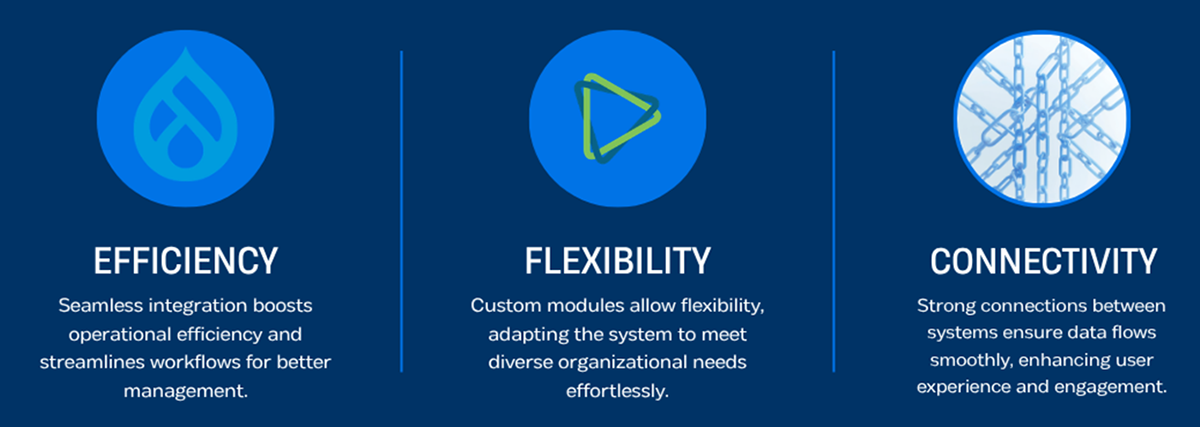
The CiviCRM Entity module is the foundation of the Drupal-CiviCRM connection. It exposes CiviCRM records as native Drupal entities, which means the rest of the Drupal ecosystem can interact with your CRM data directly.
That one integration unlocks a long list of tools that organizations already use: Views for dynamic listings, Rules for automated workflows, Search API for structured and semantic search, Layout Builder for custom page design, and the Drupal AI module for connecting CRM data to language models.
Other modules extend this further. Webform CiviCRM connects your forms directly to CRM records. CiviCRM Member Roles and Group Sync tie membership status to site access. CiviCRM Commerce Event Registration handles paid event workflows. Each of these exists because a community of developers and organizations invested in building and maintaining them.
Skvare maintains several of these modules. That is not incidental to what we do. It is central to it.
Drupal 12 Is Coming. The Work Is Already Underway.
Drupal 12 is scheduled for release in Q4 2026. For organizations evaluating platforms or planning technology spend, this is a relevant data point, and it connects directly to a question that appears in nearly every serious RFP: what does the product roadmap look like?
The honest answer for Drupal and CiviCRM is a good one. The required changes for Drupal 12 compatibility have already been merged into core and will be included in an upcoming release. The work is not hypothetical. Organizations that want to test it now can do so at github.com/jackrabbithanna/drupal12-civicrm-proto.
The ecosystem modules Skvare maintains are already on a path to Drupal 12 compatibility. We are not waiting for the release to start that work.
This matters for two groups of organizations. Those already running CiviCRM and Drupal can plan their upgrade path with confidence. Those evaluating a new system can choose knowing the platform has a clear, active, well-supported future.
What This Means for Your Technology Investment
Technology decisions at the platform level have long tails. The CMS you choose today shapes what you can do for the next five to ten years. A platform with a strong roadmap, an active community, and deep integrations protects that investment. One that stagnates or loses community support erodes it.
Drupal's community is large, organized, and growing. Its architecture anticipates where the web is going, not just where it has been. Its integration with CiviCRM is deep, actively maintained, and expanding.
For any organization asking whether their current system will hold up, or whether a new investment will still make sense in five years, those facts are worth weighing carefully.
If you want to talk through what this means for your specific setup, reach out at [email protected] or via our contact form.